Adding Value: Why BESS Technology is critical for the energy transition
Christian Sanchez P.E. is a clean energy leader with over a decade in the sector, delivering some transformational projects during his career. Since December 2024, Christian has been leading Zelestra’s engineering efforts for Battery Energy Storage Systems (BESS), ensuring optimal performance, reliability, and cost-effectiveness. He manages a global team of engineers and technical staff on implementation of BESS projects, from concept to commissioning. Here he discusses his career so far, the evolution of BESS technology, and his views on the future of the technology and the sector.
Why is BESS technology so important for the energy transition?
We can’t transition to a decarbonized grid without a high penetration of energy storage. The good news is that BESS (Battery Energy Storage System) technology is already accelerating the deployment of clean energy across the world because it adds value at every stage on the energy transition journey, and the value it brings depends on the end-user.
- At a utility-scale, for utilities, batteries are critical for enhancing grid reliability and resiliency as well delivering many important additional services, such as frequency regulation.
- For commercial and industrial customers, batteries are vital to ensure that an ever-increasingly need for power for business operation can be supported with firm and flexible clean energy.
- And at an infrastructure investor level, like traditional energy traders, the growth of BESS tolling agreements is helping them get attractive revenues from energy markets while providing grid services.
In my role leading Zelestra’s global team of BESS experts, battery technologies anchor our ability to work with customers at every level to co-create bespoke multi-tech solutions that match their exact needs. With the BESS capabilities we have, alongside our expertise in solar, wind and green hydrogen, we have all the elements needed to be truly innovative in our product design.
I anticipate continuing technology improvements and cost improvements in BESS technology, so I am very bullish about its role in the energy transition in the short, medium and long-term.
Tell us a little about your career and the advances that you have seen in energy storage in that time.
With 12 years of experience in renewable energy and grid infrastructure, including one of the largest BESS projects in the US (two 500 MW BESS, plus 500 MW solar PV in California) and a 765kV transmission line expansion in Indiana, I have been at the centre of an industry that has boomed globally.
The US has been at the forefront of battery storage revolution. Much of the growth can trace its roots to PJM (regional transmission organization that coordinates the movement of wholesale electricity in 13 States in Eastern US) when grid operators needed solutions for ancillary services, such as frequency regulation, frequency response and voltage control. There was a huge demand for 15 minutes to one hour discharge duration technology, and batteries quickly and competently stepped up to the challenge. BESS immediately proved its worth to the grid.
Around the same time the massive growth in renewables deployment picked up speed, led by States such as Texas (ERCOT) and California (CAISO). Battery growth in this context was driven by different but equally critical services for the energy system - combating the “Duck Curve” in California and adding much needed peak shaving capacity during extreme weather events in Texas, despite this state not having a capacity market.
The duck curve occurs when the electricity system is oversupplied with excess solar generation in the middle of the day but then sees a large drop-off in generation when the sun sets.
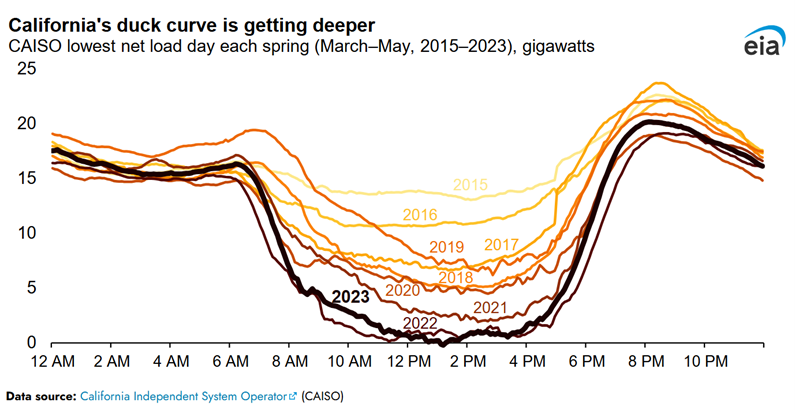
In order to store the excess power from the mid-day sun and discharge that clean energy when the sun goes down, California and Texas accounted for over 80% of all newly installed BESS capacity in the US in 2024.
Elsewhere, we are also seeing growth in areas such as the Pacific Northwest (PNW) and the SERC region where utilities want solar plus storage projects for resiliency in the phase of regional weather events. Now as a standard, more solar projects are being built with battery storage, and batteries are increasingly being contracted to help combat the impacts of extreme weather events.
From a global perspective, what interesting market dynamics are you witnessing?
In Europe, I see Italy as a leader in the deployment of battery storage. Supported by strong government policy and a capacity market mechanism, the Italian TSO, Terna, estimates that Italy needs to deploy 72 GWh of new energy storage by 2030 to meet its decarbonization targets and effectively integrate renewables, including pumped-storage hydropower. There is a difference in market dynamics between north and south, and deployment depends on the structure of agreements with off takers, but there is a lot of opportunity to fit batteries into the grid.
If we look at Germany, it is now experiencing a similar trend to that of California’s Duck Curve – as more solar projects have come on to the system - and that change in supply and demand profile is being supported by battery storage. In 2024, BESS installations in Germany increased by 50%.
Interestingly, in Latin America, increasing demand for battery storage is being driven by private businesses seeking firmed clean energy capacity to match their operations. Zelestra just signed an innovative multi-technology solution with Abastible in Chile that utilizes a 220 MWdc solar PV plant and a 1 GWh battery energy storage system. This is an incredibly creative solution that we collaborated on closely that will allow Abastible to have access to renewables capacity in night-time hours and expand its carbon-free energy portfolio. Elsewhere, we are seeing demand for similar complex solutions from industrial clients who need access to round-the-clock clean energy.
In India, the growth has driven by a coordination between the government and government-owned utilities, where we have seen rigorous planning to analyze the rollout of batteries to support grid reliability, alongside designing upgrades and the expansion of the grid network. The trifecta of clean energy projects, where solar PV, wind and energy storage is combined, has become a central to government planning, because it delivers flexible, dynamic, and clean energy sources.
Zelestra was very recently awarded a Firm & Dispatchable Renewable Energy contract by SJVN that will allow us to build a transformational 500 MW hybrid megaproject combining solar, wind and energy storage technologies in Solapur, Maharashtra.
The project will be able to deliver 24/7 green energy and also, critically, ensure supply of clean energy during morning and evening peak hours, when demand from the grid is at its highest. It will include approximately 250 MWdc of solar, 180 MW of wind power and a 90 MWh battery energy storage system.
What are your views on the outlook for BESS costs and technology advancements?
Lithium-ion chemistry is going to be the leading solution deployed in energy storage globally for many years ahead. This technology, in a wide range of durations, is proven, it is scalable, it is cost-effective, and it can solve a wide range of complex problems for customers. It can support the grid at all voltages, and it can support most needs of industrial, commercial, and residential clients.
The latter means BESS projects are flexible in terms of where they can be sited, at different sizes, with a convenient footprint, and can be used for a number of applications or solutions for the grid or end-users.
For lithium-ion technology, I see at least five more years of price decreases at the cell level. I can also see the energy density increasing at the cell level and at the container level due to the learning curve and better manufacturing experience over time.
We also have a big breakthrough on the horizon. Today we use 1500 volts DC for the power electronics of the batteries, but we are seeing 2,000 volts DC technology applications in advanced development.
By increasing to 2000 volts, we can increase the density of battery strings even further without the need for other adjustments. Going to 2000 volts DC automatically increases the volume per container, which will decrease the price of the materials, the balance of plant, construction, and the overall system-level price. This major advancement could deliver double-digit percentage overall price decreases.
In the market today we see also uses for other technologies, from flow batteries, sodium-ion batteries, solid-state batteries and even lead acid batteries. They will all have a role in the energy transition depending on what the end-user values more, whether that’s energy density, cost, fire safety, efficiency or maintenance
Some of these chemistries work better for residential needs, or specific commercial applications. Depending on grid challenges, utility-scale solutions may need to deploy more than one technology, and of course long-duration storage, over 12-hour duration, will play a very important role in the energy transition. To maximize its effectiveness, we will need a wide range of technologies that can be deployed in different locations to provide upwards of a duration of 12-hours or multiple days.
How are customers driving the evolution of battery storage?
Batteries have evolved in the last decade driven by customer needs. This is precisely what will shape future innovation as well. The need to overcome duration challenges, or power capacity challenges, or geographical challenges.
I speak to customers every day at Zelestra, and I have witnessed how their challenges have evolved over the last 10 years. Zelestra is already demonstrating its ability to deliver highly customized solutions to meet complex needs, and we are constantly evolving and developing new market and customer driven products.
The energy transition will not slow down, and neither will the changing needs of customers. As an engineer, I am excited about challenging myself every day to keep ahead of every curve, duck curves included.